For a great many ground - mounted photovoltaic projects, the adjustable solar racking is turning into a quite practical choice. It has more flexibility compared with the fixed - type brackets and is also much less expensive than the fully - automatic tracking systems.On - site engineers and operation - maintenance teams need to figure out the core operation logic of these systems which can ensure the long - term stable operation of the systems and truly realize the annual power generation.
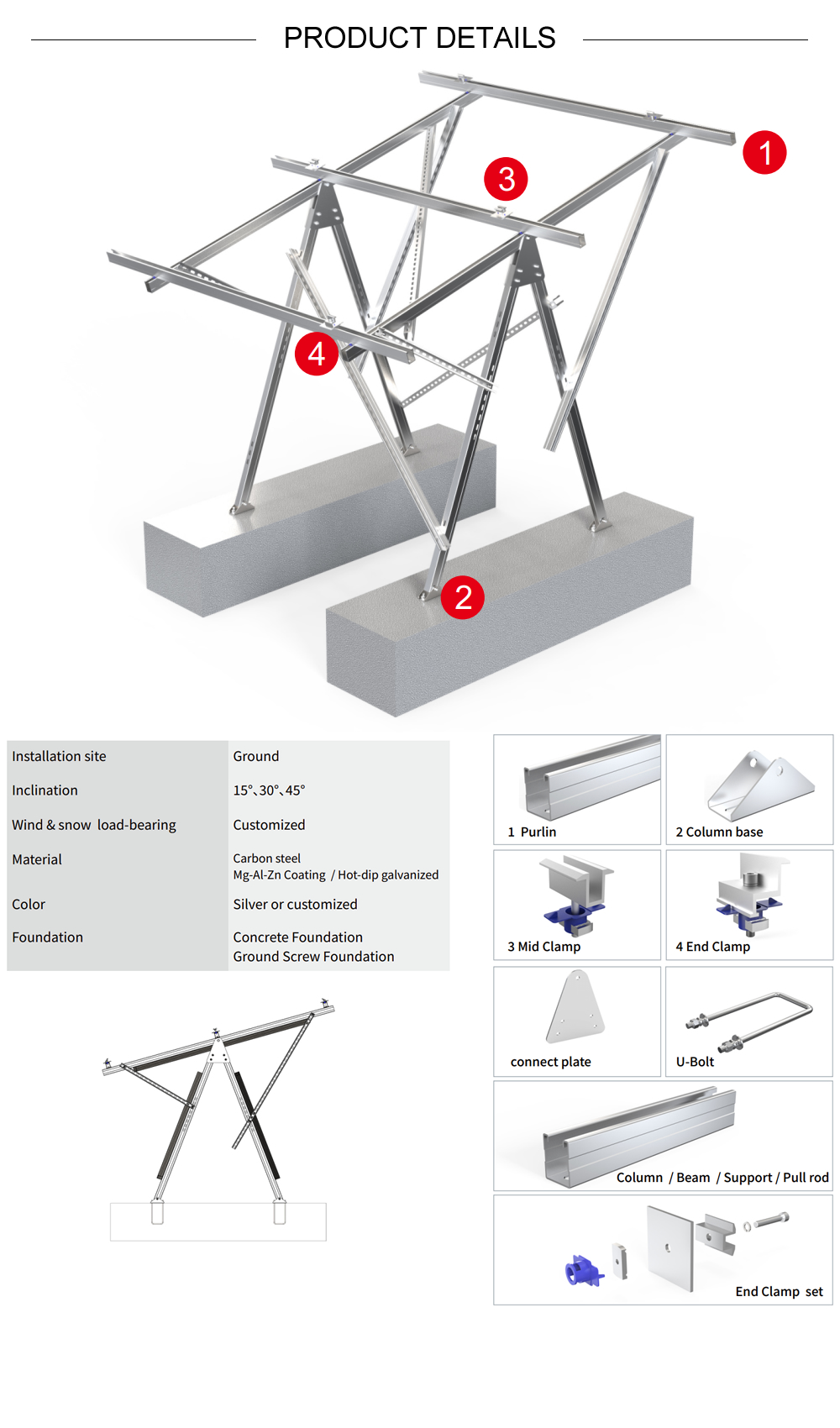
1. Installation Phase: From Foundations to Angle Adjustment
First of all the basic design should place the soil condition in the first position. The adjustable solar racking can generally make each row independently adjust the angle which means that the positioning accuracy of the column is quite important.It is proposed to use a laser range finder when arranging, making sure that the vertical and horizontal deviations of all columns in the same row are all maintained within plus or minus 5 millimeters.
If the deviation is too large, the connecting rod of the adjustment mechanism may possibly get stuck there, and it is likely to cause the adjustable solar racking to be unable to well change the inclination angle.
When installing those adjusting mechanisms, one should pay attention to the lubrication thing. What do most adjustable solar rackings use? They use screw rods, electric actuators or manual pin systems and so on. For the manual - adjustment type, the long - lasting and water - resistant lubricating grease is applied between the lead screw and the nut. Do not use ordinary lubricating oil as it is prone to hardening in outdoor environments. After installation, perform a full-stroke test: adjustable solar racking support from the minimum angle to the maximum angle and check if there are any abnormal noises or jamming situations. If electric actuators are to be used, the limit switches need to be calibrated in such a way that the motor is prevented from overloading and burning out.
Additionally when installing one should leave extra cable length since the adjustable solar racking will change the positions of the panels the DC cables must not be tied too tightly then.It is proposed that plastic cable chains or spiral sleeves be installed on the support beams, and then when the adjustable solar racking moves, the cables are able to have some movement.Numerous on-site accidents happen because the cables are pulled apart, causing damaged insulations and leading to ground-fault occurrences.
2. Operation and Maintenance Phase: Regular Inspections and Angle Adjustment Strategies
The operation and maintenance of adjustable solar mounts are slightly more complex than those of fixed mounts, but they are not difficult once you understand the principles. Generally, the angle needs to be adjusted 3 to 4 times a year, corresponding to the typical sun elevation around the spring equinox, summer solstice, autumn equinox, and winter solstice. Specific operational recommendations are as follows:
In winter the angle which is set as the local latitude plus ten to fifteen degrees, this steep angle that helps the snow to slide off from the board and also captures the low - angle sunlight.After adjustment, one needs to go to check the lock mechanism of the adjustable solar racking to see whether it is completely locked properly so as to prevent the components from being blown down by strong winds.
During summer, the angle is set to be your latitude minus 10 to 15 degrees. At this angle, the adjustable solar racking is nearly horizontal, therefore special attention should be paid to the drainage and ventilation conditions.If there are frequent sandstorms in your area, it is suggested that the component frames and installation rails be rinsed once a month with a high-pressure water gun with a pressure lower than 5 megapascals so as to prevent the impact of excessive dust accumulation on the adjustment precision.
In addition to seasonal adjustments, O&M personnel should conduct a visual inspection every three months. Focus on the following components:
Let's take a look at the surface of the adjusting screw or electric actuator to check if there are any rusty, scratched or bent items.
For the manual adjustable solar racking, a common problem is the wear of the pin. If after insertion the pin sways by more than 2 millimeters, then it either needs to be replaced or a gasket needs to be added.
Because when the angle is adjusted, the overall center of gravity of the support will change, so the pre-tightening force of the foundation bolts may reduce. It is proposed to randomly conduct spot checks on 10% of the bolts by using a torque wrench and then re-tighten them to 110% of the design torque value.
3. Common Faults and Quick Fixes
Power plants that have used adjustable solar mounts for a period longer than two years are very likely to have two types of defects. First, there is jamming during manual adjustment, which is often because of debris or rust particles in the positioning holes.A rather simple solution is presented: a steel wire brush with a diameter one millimeter smaller than the positioning hole is used to clean the inner wall of the hole, and then a small amount of anti - rust lubricant is sprayed.The second issue is the desynchronization of electric actuators. In a large adjustable solar racking array, if the strokes of a set of actuators are inconsistent, the whole linkage shaft which may be distorted and damaged may occur.The solution is that prior to every adjustment, one should first reset to the minimum angle so that all actuators return to zero and then start them at the same time.
Moreover, many property owners will ask: does each adjustment of angle require insulation test? For the adjustable solar installation system, it is not that each adjustment requires test, however it is suggested to conduct a DC insulation resistance test before winter to ensure that cables and connectors are not damaged due to repeated bending.
4. Summary
A well - developed technical scheme is the adjustable solar installation system that has obvious returns. As long as during installation the alignment of the pillars is carefully controlled, the adjustment mechanism is properly lubricated, sufficient cable slackness is provided, and during operation and maintenance the connectors are simply visually inspected and maintained every quarter, then this system can operate reliably for more than 15 years.For the projects which desire to increase power generation without making investments in dual-axis trackers, the adjustable solar racking with relatively good cost performance is indeed quite good.Keep in mind that appropriate adjustments of angles can ensure the continuous and stable power generation; comprehensive maintenance can indeed guarantee the reliable returns.


